

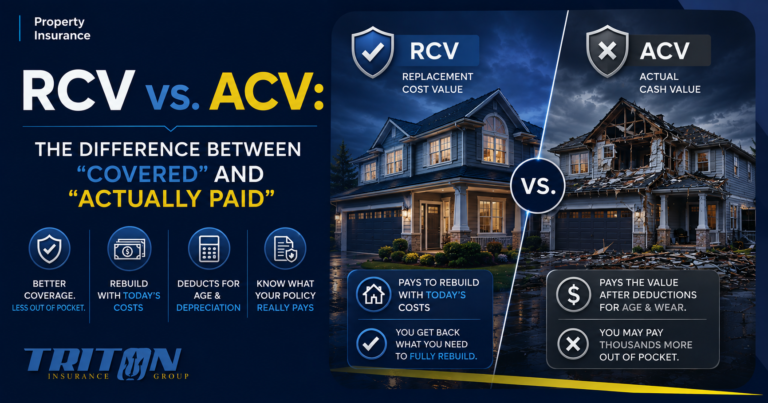
RCV vs. ACV: The Difference Between “Covered” and “Actually Paid”
When shopping for homeowners insurance, it’s easy to focus on the premium, deductible, and coverage limit. But there’s another detail that can make a major difference when you file a claim:
How will your property be valued when it’s damaged or destroyed?
Two terms you’ll often encounter are Replacement Cost Value (RCV) and Actual Cash Value (ACV).
They may sound similar, but they can result in very different claim payments.
Florida’s Department of Financial Services explains that replacement cost generally refers to the cost to repair or replace damaged property with materials of similar kind and quality without deducting depreciation. Actual cash value, on the other hand, accounts for depreciation based on the property’s age and condition. FLDFS
Understanding that difference before a loss occurs can help you better understand what your policy may actually pay.
What Is Replacement Cost Value?
Replacement Cost Value (RCV) is generally based on what it costs to replace or repair damaged property with materials of similar kind and quality, without subtracting depreciation.
For example, imagine you purchased a refrigerator several years ago for $3,000. A similar refrigerator now costs $3,500.
Under replacement cost coverage, the valuation can be based on the current cost of replacing the refrigerator, subject to the terms, conditions, limits, and deductible of your policy. Florida’s Department of Financial Services uses a similar refrigerator example in its consumer guidance.
What Is Actual Cash Value?
Actual Cash Value (ACV) generally takes depreciation into account.
In simple terms:
Replacement Cost − Depreciation = Actual Cash Value
As an item gets older, its value may decrease because of age, wear, and condition.
For example, if a five-year-old refrigerator is damaged and a comparable new refrigerator costs $3,500, the ACV calculation may account for the refrigerator’s age and remaining useful life.
The result can be substantially lower than the cost of buying a new replacement.
Why “Covered” Doesn’t Always Mean “Fully Replaced”
This is where the difference between being covered and knowing what you’ll actually receive becomes important.
A homeowner may see that a particular type of loss is covered by their policy and assume the insurer will simply pay whatever it costs to purchase a new replacement.
But coverage and valuation are two different questions.
First:
Is the loss covered?
Then:
How does the policy calculate the value of the damaged property?
That’s why understanding the settlement basis before a loss occurs matters.
RCV Doesn’t Mean “Unlimited Coverage”
This is an important distinction.
Replacement-cost coverage doesn’t mean an insurer will automatically pay any amount necessary to rebuild or replace everything.
Your policy still has:
- Coverage limits
- Deductibles
- Exclusions
- Conditions
- Eligibility requirements
- Specific valuation provisions
Florida’s Department of Financial Services also notes that many replacement-cost policies require homeowners to carry insurance equal to a certain percentage of the property’s replacement value—often 80%, although requirements can vary by policy. Failing to maintain the required amount can affect payment for a partial loss. FLDFS
So RCV is only one part of the coverage equation.
Don’t Compare Policies on Premium Alone
A policy with a lower premium may look attractive until you compare how claims are valued.
When reviewing insurance options, consider the entire policy—not just the price.
Look at the combination of:
Premium + deductible + coverage limits + exclusions + valuation method + additional coverage
That’s a much more meaningful comparison than the premium alone.
Know What “Covered” Means Before You Need It
Insurance is designed to provide financial protection when something unexpected happens. But the details of your policy determine how that protection works.
RCV and ACV are two important concepts that can influence what a claim payment looks like.
You don’t want to wait until after a loss to discover that you misunderstood how your property would be valued.
At Triton Insurance Group, we can help you review your current policy, explain the differences between coverage options, and compare available policies from multiple carriers.
Because knowing you’re covered is one thing. Knowing how your claim could actually be paid is another.
GET A FRESH LOOK AT YOUR COVERAGE
Or reply directly to this email or contact us today to discuss your insurance options.
Best regards,
Triton Insurance Group
(305) 842-3601
info@totalpropertyinsurance.com